NEIL CORNRICH & NC SPORTS: MANAGING THE CAREERS OF PROFESSIONALS IN THE SPORTS INDUSTRY

SEARCH NEILCORNRICH.COM

Tuesday, June 06, 2023

Like Steph Curry? Or Katie Smith? On comparing women’s players to NBA vs. WNBA stars


By Richard Deitsch

Jun 5, 2023


Diana Taurasi is an impassioned and opinionated person, and when a person offering opinions also has the gravitas of being on the short list of the greatest players in the history of her sport, which is where Taurasi sits, there is a bit of an E.F. Hutton impact: People listen.

Last Thursday, during a Phoenix Mercury post-practice media availability, Taurasi offered her thoughts on a variety of topics, including a really interesting answer about broadcasters making comparisons when it comes to women’s college basketball and WNBA players. After watching a recording of Taurasi’s five-minute session, I transcribed the media-centric part and sent out the following on Twitter:


The tweet as of this writing has 750,000 impressions and produced a lot of thoughtful answers (a rare moment on Twitter these days). I wanted to explore Taurasi’s thoughts further because I thought she made a really astute observation and one worth thinking about. As someone who has covered women’s basketball and is a huge consumer and admirer of the game, I am positive in some past pieces I made a comparison of a women’s player to a men’s player, and I definitely recall one story I wrote for Sports Illustrated where I quoted Maya Moore comparing Breanna Stewart to Kevin Durant.

Both the WNBA and women’s college basketball are at places in their evolution where comparisons of today’s players can certainly be made to other players or players from the past. So over the weekend, I reached out to Rebecca Lobo, the Hall of Famer who has called women’s basketball for ESPN since 2004, and showed her Taurasi’s comments.

“I think Diana’s point is fair,” Lobo said. “There’s now 27 years of WNBA players to use as comparison for the current crop. This is something I think about every year when preparing for the WNBA Draft. We always want to find a player’s comp to someone who has had success already in the league. I can usually come up with a former WNBA player or a mash-up of a few players. That being said, there are players like Caitlin (Clark) who have traits that might compare better to an NBA player. This season, Ryan Ruocco and I talked a lot about Caitlin’s get-ahead passes being the best since Sue Bird. Holly Rowe talked about Caitlin’s fire and competitiveness resembling Diana’s. But her range? We haven’t seen anything like that consistently in the women’s game. I’ve been in it (WNBA) since the beginning, and what Caitlin is consistently doing in that regard has not been done before. So I think Steph (Curry) is the fair comparison point on that.

“Who is the comparison for Alyssa Thomas?” Lobo continued. “The way she rebounds and leads the break, LeBron (James) might be the best comp. Who is the best for (Stewart)? It might be KD. Or is it Lauren Jackson? Maybe both should be mentioned? But should broadcasters of the women’s game try to make comparisons to other women? Yes. Just like current college players, when asked who their favorite team or pro player is, should probably say a WNBA player or W team. That will happen as the game continues to grow. There is a responsibility on broadcasters to know the history of the game in order to make those comparisons. And to know when there isn’t one.”

One person on Twitter to respond earliest to my post was a user named Nick Davies based in the Portland area. He offered a thought that echoed many of the good-faith comments. “I understand what she’s saying, but in order to grow the audience, I think you need to make references a casual fan would understand,” Davies wrote. “But maybe it’s about mentioning both. She rebounds like (Dennis) Rodman and (Rebekkah) Brunson.”

There were readers who followed up on Davies’ comment and suggested the comparison to a popular NBA player might prompt someone who doesn’t watch much WNBA or women’s college basketball to look up the women’s player as a result of a men’s player being mentioned. Monica McNutt is part of the post-Lobo generation of former women’s basketball players who now seamlessly switch between calling WNBA and women’s college basketball to the NBA. McNutt is a big part of ESPN’s women’s basketball coverage as well as a studio analyst for the Knicks on MSG Networks. She also covers the NBA Draft for ESPN.

“I think (Taurasi) is on to something, and it’s a challenge I’m personally down to accept,” said McNutt, a captain at Georgetown who led the Hoyas to a Sweet 16 appearance as a senior in 2011. “The recent boom in women’s sports consumption makes her comments timely. As little as three to five years ago, frankly, I don’t think her comments track as well or create the same dialogue. Caitlin Clark being compared to Steph Curry is pretty self-explanatory, as is Angel Reese rebounding like Dennis Rodman. It’s an easy conversation starter that a casual fan would pick up. I know during our women’s Final Four coverage, we also made comparisons of aspects of Caitlin’s game to (Taurasi) and Sue Bird and Angel’s rebounding to Sylvia Fowles or Teresa Weatherspoon with the attitude and flair.”

Cindy Brunson is the play-by-play voice of the Mercury with a long and distinguished career calling women’s basketball for the Pac-12 Networks and FS1 among other entities. She was a studio host with ESPN for 13 years, with hundreds of hours as a SportsCenter anchor. She said the women’s game has evolved enough to invite its own comparisons.

“The level of competition has increased to the point where the women’s game can easily celebrate its own history,” Brunson said. “Let’s embrace that. I’m so lucky. I sit alongside Hall of Famer Ann Meyers Drysdale, a pioneer who is a walking encyclopedia when it comes to all of the greats in women’s basketball. We’re intentional about tying the legacies of amazing hoopers from previous generations to the incredible product in front of us today. When we see Caitlin Clark, we compare her to Diana Taurasi. The swagger, the lethal range from 3, and the court vision is vintage DT. Not to say we ignore the NBA. We shouldn’t. Mercury players serve as broadcasters on Suns games and as a result, find themselves wanting to bring elements of Devin Booker’s or Kevin Durant’s game into their own. They’re fun to watch and our players are too —we talk about that connectivity on our telecasts.”

Something I wonder about is whether the time will come in my lifetime when NBA players are compared to women’s players during a men’s college game or an NBA game when it comes to style of play, competitive drive or something similar. That’s not something I can remember hearing on a men’s basketball broadcast. McNutt, who crosses into each world, believes it will happen in time.

“As recently as last year, when Jaden Ivey (whose mother, Niele Ivey, coaches Notre Dame and was a great college point guard) was drafted to the Pistons, his very unique relationship with women’s basketball was part of the fabric of his story,” McNutt said. “He’s said he emulated parts of his game after Arike Ogunbowale and Skylar Diggins. Paolo Banchero, last year’s No. 1 pick has talked about the influence of his mom as a hooper. Tyrese Haliburton has talked about growing up loving women’s ball because his dad coached girls. This can happen especially as more women’s hoopers are becoming cultural icons like this major hits tour Angel Reese is on. So even folks that don’t work in both men’s and women’s sports can’t miss it.

“I don’t think not comparing guys to women is a slight, though. Historically, there’s 50 more years’ worth of NBA players to compare a guy to. But it can be done and will, and I think this generation of hooper and hoop fan is more into just ball no matter who’s playing than their predecessors. So they’ll be even more receptive.”

Brunson pointed out something that’s really important on this issue — representation. The NBA has seen an influx of play-by-play and game analysts with deep ties to women’s basketball including Lisa Byington (Bucks), Kayte Christensen (Kings), Sarah Kustok (Nets), Rowe (Jazz), Kate Scott (Sixers) and Katy Winge (Nuggets), among others. Candace Parker and Chiney Ogwumike are current WNBA analysts who have major NBA broadcasting gigs nationally.

“As for seeing a men’s player compared to a women’s player, it’s coming,” Brunson said. “As new voices are invited to bigger platforms, it’s my hope we’ll see those informed gender comps happen organically. If you’d asked me 10 years ago if I thought a woman would be the TV voice for an NBA team, I would’ve thought that was a pipe dream and now there are two in Kate Scott and Lisa Byington. I’m a big believer that anything is possible and can’t wait to see what the future holds.”


Monday, June 05, 2023

Iowa Football: Dallas Clark nominated for NFF 2024 College Football Hall of Fame


Former University of Iowa unanimous Consensus All-American tight end Dallas Clark is listed on the ballot for the National Football Foundation (NFF) 2024 College Football Hall of Fame.


DAVID EICKHOLT


IOWA CITY, IA-- Former Iowa tight end Dallas Clark is one of the most beloved players in the Kirk Ferentz era. On Monday morning, it was announced that he is listed on the ballot for the National Football Foundation 2024 College Football Hall of Fame. It's the third season in a row.


As the Hawkeyes entered a critical 2002 season, Clark's emergence at tight end help change the course of the Ferentz tenure. Clark finished with 43 catches for 742 yards and four touchdowns, while winning the John Mackey Award, which goes to the nation's top tight end. 


Clark departed with a year of eligibility remaining and was drafted in the first round. After being in the NFL for a couple seasons, Clark opened up about some of the differences between college and professional. 

"The pro game is more of a business, yet still a game, it is a business," Clark previously told HawkeyeInsider. "You are your own company so you have to be ready everyday is the best way to explain it. The biggest thing is that it is your job. You get paid for it and have to perform every day for practice and be ready. It is just different that way. That makes it interesting but it is what it is."


Clark remains a fixture in the Hawkeye community. During Iowa's open spring practice, he was recognized for his contribution of $101,000 to the UI’s Stead Family Children’s Hospital. He can often be found at Hawkeye practices and inside Kinnick Stadium. 

Below is the full press release courtesy of Iowa Athletics. 

Former University of Iowa unanimous Consensus All-American tight end Dallas Clark is listed on the ballot for the National Football Foundation (NFF) 2024 College Football Hall of Fame.

Clark in 2002 was named first-team All-America by the Football Writers Association of America, American Football Coaches Association, Walter Camp, Associated Press, Sporting News, ESPN and CNN-SI. He won the John Mackey Award as the nation’s best tight end and was first-team All-Big Ten by both league coaches and media. Clark finished his career in 17th place on Iowa’s career receiving list with 1,281 yards and eight touchdowns on 81 receptions in just two seasons at tight end.


The native of Livermore, Iowa, joined the Iowa program as a walk-on linebacker and was drafted in the first round of the 2003 NFL Draft by Indianapolis following his junior season.

Clark played 11 seasons in the NFL, totaling 5,665 receiving yards and 53 touchdowns while also earning a Super Bowl championship with the Indianapolis Colts.

Former Hawkeye offensive tackle Robert Gallery, a 2003 consensus All-American and recipient of the Outland Trophy, is a member of the 2023 NFF College Football Hall of Fame.


UW Athletic Hall of Fame: Montee Ball


General News June 05, 2023 Nate Jelinek

One of the best running backs in school history now helps teens and young adults in his community

MADISON, Wis. — The first edition of the Big Ten Football Championship Game, in 2011, was an instant classic. In a back and forth affair on the Lucas Oil Stadium turf in Indianapolis, Wisconsin running back Montee Ball scampered for 137 yards and three scores on the ground. In a well-rounded offensive performance, the UW junior also grabbed a touchdown catch and completed a 32-yard pass to quarterback Russell Wilson.

On the other side of the ball, the Badger defense was tasked with containing future NFL stars Kirk Cousins and Le'Veon Bell. Chris Borland, a redshirt sophomore linebacker, made seven tackles.

After a 7-yard Ball touchdown run with 3:45 to play, the UW defense held on to seal the 42-39 victory and send the Badgers to Pasadena for a second consecutive season.


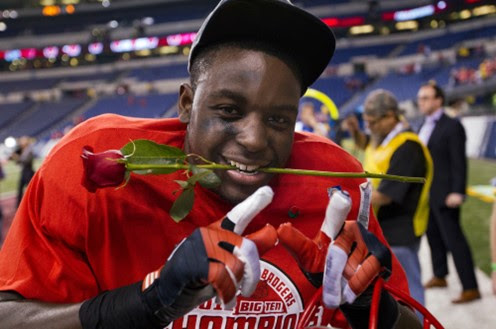
Wisconsin Badgers running back Montee Ball (28) celebrates a victory after the Big Ten Football Championship NCAA football game against the Nebraska Cornhuskers Saturday, December 1, in Indianapolis. The Badgers won 70-31 to send the team to the Rose Bowl.


More than 11 years after that rollercoaster evening in Indy, Ball and Borland grabbed coffee in Madison this spring. Ball, who was in town for a speaking engagement, had time to catch up with his former teammate before his flight home.

"We were drinking coffee and (Chris) asked me what time my flight was," said Ball. "He was like, 'Hey, Mac wants to chat with you.'"

Later that morning, Borland and Ball arrived at Kellner Hall and stepped into the office of Wisconsin Director of Athletics Chris McIntosh, overlooking Camp Randall Stadium. McIntosh shut the door.

"He let me know that I was going to be inducted into the hall of fame," said Ball.

"I was immediately blown back. I was caught off guard. I was not expecting it whatsoever. And of course, I immediately started to tear up, because it means a lot to me."


Borland, who was in on the surprise, stood by as Mac delivered the good news.

"Obviously, Mac had shared it with him," said Ball. "I looked at him and was like 'you son of a gun.' So, it was obviously an amazing moment. They had the Kleenexes ready for me. I was just looking out on the field just reminiscing on everything. It just came at me really quickly and it was again, just a moment that I'll never forget."

Monday, June 5 will be another day Ball will remember for a long time. Not only was that the day Ball's UW Athletic Hall of Fame induction was officially announced but it coincided with the announcement of his inclusion on the 2024 College Football Hall of Fame ballot. He is one of 78 FBS players to be selected for the ballot. If chosen, Ball would be just 13th player in Badger history to be enshrined in the College Football Hall of Fame. The voting results will be
announced in January, 2024. 

UW Athletic Hall of Fame: Montee Ball


Top Five

One: In a Badger uniform on Saturdays, Ball assembled one of the most impressive careers for a ball carrier in both UW and college football history. In a Badger football record book that includes legends like Ron Dayne, Jonathan Taylor, Melvin Gordon and James White, Ball ranks third all-time with 5,140 career rushing yards. By splitting time with Gordon, White and John Clay, Ball competed directly for carries with peers who combined for six 1,000-yard seasons and 58 100-yard rushing performances.

In 2011, Ball scored 39 total touchdowns, matching the legendary Barry Sanders' NCAA single-season record. He totaled 1,923 rushing yards, the most in the country, and was a finalist for the Heisman Trophy. That fall belonged to Ball.

"We had such an emphasis in 2011, starting from summer conditioning and into training camp, where we just told each other that when we get the opportunity to score, we must score a touchdown," said Ball. "We must finish the drive. We wanted to dominate, we wanted to score."

Ball went on to finish his Wisconsin career with a school record 77 rushing touchdowns and a then-FBS record 83 total touchdowns.

Two: As part of that historic 2011 season, Ball's performance in the Big Ten Championship helped propel the Badgers to the Rose Bowl. Ball remembers the matchup against Michigan State in Indianapolis as one of the greatest games he played in.

"Watching the fans travel to Indianapolis and fill the stadium, seeing the scene in there, and just the emotions from that game, those are things I'll never forget."

After a last-second defeat at the hands of the Spartans in East Lansing earlier in the season, the revenge was sweet for the Badgers.

"I love that Michigan State memory because we wanted to get that revenge so bad on them from that Hail Mary. We were able to get that revenge."

The Badgers then ascended on Southern California for the Rose Bowl, the second of three that Ball would play in during his career. Ball totaled three separate 100-yard rushing performances in those games, the only player in the illustrious history of the 'Granddaddy of Them All' to accomplish that feat.


Three: The big moments in those seasons were shared with teammates who bought in and worked to be part of something bigger than themselves.

"We had some great players on both sides of the football," he said. "We were really just flowing as a unit. In practice, we were focused. In the film room, we were focused. In 2011, I really think Russell (Wilson) brought that over to us. It helped us get over that hump of really becoming a dominant team and I think that's what we did."

Looking back, Ball recognizes the support and guidance he received from teammates and the coaching staff as the Badgers flourished in the early 2010s.

"I think when you look at those 2010-2012 seasons, I really believe Barry (Alvarez), Coach (Bret) Bielema and the coaching staff did a great job of putting people in the right positions to really allow us to be successful."

When reflecting on his career, Ball was quick to credit others for their impact on his career and legacy. The greatness inside those Badger running back rooms helped Ball make his mark as a generational talent.

"With those running backs that were in the room with me, I believe there's no way that I'd be in consideration for the Hall of Fame if it wasn't for those guys pushing me. I had to perform better in order to just be on the field because that's how good they were."

Off the field, Ball recognized that his support group helped pave the way for his success between the lines.

"I also want to thank my family. My parents, my sisters, my grandmother, my uncle and every single person who supported me throughout my whole journey from a young age. This honor is something I'm sharing with them as well."

Four: Ball's experience with dark days and adversity is part of his personal journey as well. With the highs of his athletic career, collegiately and professionally, Ball also dealt with lows that included bouts with alcoholism.

Through the many trials and tribulations Ball weathered during his career as a Badger, an NFL player and as a person, the recognition from his alma mater provided a full-circle moment. Ball, who was emotional upon learning of his inclusion into the UW Athletic Hall of Fame, wasn't sure this day would ever come.

"I didn't think this would be in the works for me," he said. "Let's just call a spade a spade here, I've made some mistakes that I've made amends about and that I've taken ownership for. I'm still in long-term recovery to this day. So, today this means so much. When I signed my letter of intent to become a Badger, I was told that once you're a Badger, you're always a Badger. I think this right here, proves it."

Five: These days, Ball is living in Denver and working as a licensed realtor and a clinical outreach ambassador at Sandstone Care, a treatment facility.

"My day-to-day, is not only focused on myself and my son, Maverick, but outside of that, I give back to communities," said Ball. "And now, what I'm doing, is giving back to teens and young adults, regarding addiction treatment. It fills my cup as well. And that's what I'm going to keep doing.

"And now I can say I'm a Hall of Fame running back at the University of Wisconsin."


Popular Posts