NEIL CORNRICH & NC SPORTS: MANAGING THE CAREERS OF PROFESSIONALS IN THE SPORTS INDUSTRY

SEARCH NEILCORNRICH.COM

Showing posts with label robert smith. Show all posts

Tuesday, September 19, 2023

173 modern-era nominees announced for Pro Football Hall of Fame Class of 2024


Published: Sep 19, 2023 at 11:08 AM


Nine players in their first year of eligibility are among the list of 173 Modern-Era Nominees for the Pro Football Hall of Fame Class of 2024


Those making the list for consideration for the first time include wide receivers Brandon Marshall and Jordy Nelson, tight end Antonio Gates, running back Jamaal Charles, offensive linemen T.J. Lang, Josh Sitton and Max Unger, and defensive linemen Haloti Ngata and Julius Peppers.


The roster of nominees consists of 94 offensive players, 62 defensive players and 17 special teams players. The list of Modern-Era Nominees will be reduced to 25 Semifinalists in November.


*Finalist in 2023. Underline indicates first year of eligibility. (Players must have last played at least five full seasons ago to be eligible for nomination. Therefore, any individual who last played in 2018 is eligible for the first time in 2024.)


QUARTERBACKS (10): Marc Bulger, Randall Cunningham, Jake Delhomme, Doug Flutie, Rich Gannon, Jeff Garcia, Donovan McNabb, Steve McNair, Tony Romo, Michael Vick


RUNNING BACKS (33): Shaun Alexander, Terry Allen, Mike Alstott, Jamal Anderson, Tiki Barber, Michael Bates (also KR), Jamaal Charles, Larry Centers (FB), Stephen Davis, Corey Dillon, Warrick Dunn, Charlie Garner, Eddie George, Ahman Green, Priest Holmes, Steven Jackson, Chris Johnson, Daryl Johnston (FB), Thomas Jones, John Kuhn (FB), Vonta Leach, Dorsey Levens, Jamal Lewis, Eric Metcalf (also WR/PR/KR), Glyn Milburn (also WR), Lorenzo Neal (FB), Tony Richardson (FB), Robert Smith, Fred Taylor, Chris Warren, Ricky Watters, Brian Westbrook, Ricky Williams


WIDE RECEIVERS (23): Anquan Boldin, Troy Brown (also PR/KR), Donald Driver, Antonio Freeman, Irving Fryar, Dante Hall, Devin Hester* (also PR/KR), Torry Holt, Joe Horn, Andre Johnson, Chad Johnson, Brandon Marshall, Derrick Mason, Herman Moore, Muhsin Muhammad, Jordy Nelson, Andre Rison, Jimmy Smith, Rod Smith, Steve Smith Sr., Hines Ward, Reggie Wayne*, Wes Welker


TIGHT ENDS (3): Ben Coates, Antonio Gates, Wesley Walls


OFFENSIVE LINEMEN (25): Willie Anderson* (T), Bruce Armstrong (T/G), Matt Birk (C), Lomas Brown (T), Ruben Brown (G), Jahri Evans (G), Kevin Glover (C/G), Olin Kreutz (C), T.J. Lang (T), Matt Light (T), Nick Mangold (C), Logan Mankins (G), Tom Nalen (C), Nate Newton (G/T), Jeff Saturday (C), Mark Schlereth (G/C), Josh Sitton (G), Chris Snee (G), Mark Stepnoski (C), Dave Szott (G), Max Unger (C), Brian Waters (G), Richmond Webb (T), Erik Williams (T), Steve Wisniewski (G)


DEFENSIVE LINEMEN (20): John Abraham (DE also LB), Jared Allen* (DE), Dwight Freeney* (DE), La'Roi Glover (DT/NT), Casey Hampton (DT/NT), Robert Mathis (DE), Haloti Ngata (DT), Leslie O'Neal (DE), Julius Peppers (DE), Simeon Rice (DE), Justin Smith (DE), Neil Smith (DE), Dana Stubblefield (DT), Henry Thomas (DT/NT), Justin Tuck (DE), Ted Washington (NT/DT), Vince Wilfork (DT/NT), Jamal Williams (DT/NT), Kevin Williams (DT), Pat Williams (DT)


LINEBACKERS (25): Jesse Armstead, Brendon Ayanbadejo, Cornelius Bennett, Lance Briggs, Keith Brooking, NaVorro Bowman, Tedy Bruschi, Karlos Dansby, Donnie Edwards, James Farrior, London Fletcher, James Harrison, Larry Izzo, Willie McGinest (also DE), Hardy Nickerson, Ken Norton Jr., Bryce Paup, Julian Peterson, Joey Porter, Takeo Spikes, Jessie Tuggle, Mike Vrabel, Patrick Willis*, Al Wilson, Lee Woodall


DEFENSIVE BACKS (17): Eric Allen (CB), Kam Chancellor (S), Nick Collins (DB), Antonio Cromartie (CB), DrĂ© Bly (DB), Merton Hanks (S), Rodney Harrison (S), Carnell Lake (DB), Tim McDonald (S), Eugene Robinson (DB), Samari Rolle (DB), Allen Rossum (DB), Bob Sanders (S), Charles Tillman (CB), Troy Vincent (CB), Antoine Winfield (DB), Darren Woodson* (S)


PUNTERS/KICKERS (15): David Akers (K), Gary Anderson (K), Darren Bennett (P), Jason Elam (K), Jeff Feagles (P), Jason Hanson (K), John Kasay (K), Sean Landeta (P), Shane Lechler (P), Brad Maynard (P), Pat McAfee (P), Brian Moorman (P), Matt Stover (K), Matt Turk (P), Mike Vanderjagt (K)


SPECIAL TEAMS (2): Josh Cribbs (KR/PR also WR), Brian Mitchell (KR/PR also RB)

Nineteen Finalists will be presented to the full 50-member Pro Football Hall of Fame Selection Committee during its annual meeting to choose the Class of 2024. Those candidates will consist of 15 Modern-Era Players Finalists and the recently named Seniors Finalists Randy Gradishar, Steve McMichael and Art Powell and Coach/Contributor Finalist Buddy Parker.


The Selection Committee will meet early next year (on a date to be determined) in advance of Super Bowl LVIII. While there is no set number for any class of enshrinees, the selection process bylaws provide that between four and nine new members will be selected.


The Seniors Finalists and Coach/Contributor Finalist are voted "yes" or "no" for election at the annual selection meeting and must receive at least 80% support from the Committee to join the Class of 2024. The Modern-Era Finalists will be trimmed during the meeting from 15 to 10, then from 10 to five. The remaining five Finalists will be voted on individually, "yes" or "no," and must receive the same 80% positive vote as the Seniors and Coach/Contributor to earn election to the Pro Football Hall of Fame.


This year's reduction voting and the selection meeting ballots will be processed via an online voting platform developed specifically for the Pro Football Hall of Fame by the firm EY.


EY has overseen the election process since the Centennial Class of 2020.


The Pro Football Hall of Fame's Class of 2024 will be enshrined in August 2024.


Tuesday, September 12, 2023

Minnesota Vikings History: Robert Smith drafted 30 years ago


As the Minnesota Vikings enter the 2023 season with an uncertain running back situation, let’s recall fondly the 30th anniversary of Robert Smith becoming a Viking.

By Ben Donahue | Aug 19, 2023


Former Minnesota Vikings running back Robert Smith / RVR Photos-USA TODAY Sports


In 1992, the Minnesota Vikings were an 11-5 team that lost in the Wild Card round to the Washington Redskins. On the roster that year were two good running backs, Terry Allen and former 49er and Raider Roger Craig. Allen rushed for over 1,000 yards in 1992, and Craig added 416.facebooktwitterreddit


Despite the fact that Minnesota had two capable backs on their roster, the team surprised the sports world when they selected Ohio State’s Robert Smith as the 21st overall pick of the 1993 NFL Draft. It turned out to be a fortuitous addition as Allen tore his ACL during summer workouts and missed all of 1993.

Although on paper, Smith was a great athlete, he represented something of a question mark. In high school, Smith received Ohio’s Mr. Football Award twice and had his choice of colleges. He ultimately chose to stay in-state and play for the Buckeyes.

Right off the bat, Smith showed he had skills by running for 1,126 yards and eight touchdowns as a freshman. His rushing total led Ohio State and obliterated former Buckeye legend Archie Griffin’s freshman mark of 867 yards.

Just when it looked like Smith would be a super sophomore, he threw OSU a curve ball. As a pre-med major, Smith was taking coursework that required long hours of study and time away from the football team.

He received pushback from the coaching staff to take different classes that would allow him more time for football. Instead of listening to their advice, Smith quit the team in August of 1991.

In an interview with Sports Illustrated, Smith accused then-Buckeyes coaches John Cooper and Elliot Uzelac of, among other charges, not being concerned about their athletes' education. In the SI article, Smith alleged that Uzelac told Smith he took school too seriously.

"Guilty as charged," said Smith in 1991. "I simply can no longer play for those two [Cooper and Uzelac]."

After leaving the football team, Smith took a scholarship to compete with OSU’s track team. During the 1991 track season, he ran a 10.24 in the 100-meter dash, a personal best. Smith then considered leaving Ohio State to play football elsewhere in 1992.

That never happened, and he returned to play for Cooper in 1992 and rushed for 819 yards and 10 touchdowns (Uzelac was dismissed). 

Although Smith still had college eligibility left, he decided to forgo his final two years and enter the 1993 NFL Draft. Minnesota believed he had shown enough promise in college, and the organization to decided to snap him up in the first round.

When Terry Allen was felled with his injury before the 1993 season, it was thought that Smith could take over the rushing load. He lasted 10 games and 399 yards before exiting the season with his own injury and a serious case of chicken pox.

Then for the next few years, Vikings fans wondered if Smith was a bust, especially when he never started more than seven games and only ran for a high of 692 yards (1996), primarily due to several more injuries.

Thankfully, the bust label never materialized. Beginning in 1997, Smith finally stayed healthy enough to break loose and become one of the best running backs in Vikings history.

In four consecutive seasons, he rumbled for over 1,000 yards, including a career-best 1,521 yards and seven touchdowns in 2000. That year he also snagged a career-best three receiving touchdowns. Meanwhile, Minnesota went to the playoffs between 1997 and 2000 and appeared in the NFC Championship game twice
.


Surprisingly, after the postseason in 2000, Smith decided to retire despite the fact that he had just tallied career numbers. In eight years with Minnesota, Smith ran for 6,818 yards and 32 touchdowns and caught 178 passes for 1,292 yards and six scores. He was selected to the Pro Bowl twice and received second-team All-Pro honors once.

Smith still owns the Vikes’ second-best all-time career rushing mark, and he holds an NFL record for average yards per touchdown at 27.2
. Smith is currently an NFL analyst for Fox Sports.


Wednesday, October 26, 2022

How Fan Huddle Is Shaking Up the Workplace Wellness Industry With On-Demand Digital Experiences Led by Professional Athletes and Experts


Fan Huddle offers hundreds of on-demand fitness and wellness video classes with categories that range from running to cooking tips.


Former NFL running back Robert Smith, a Pro Bowler for the Minnesota Vikings in 1998 and 2000, has been around the medical field for his entire life. He spent plenty of time around hospitals while growing up in a Cleveland suburb since his mother was a registered nurse. As a student-athlete at Ohio State University in the early 1990s, he took classes in biology, chemistry, and physics before the Vikings selected him as a first-round draft pick in 1993.

“I've always been interested in applied science and medicine. When I was at Ohio State, I worked at a hematology and oncology lab doing cloning and sequencing of genes,” Smith tells SportTechie. “This is all the way back in ‘91, so technology was pretty new at that point and a lot different than what’s being done now.”

Smith retired from the NFL in 2001 at 28 years old after repeated knee injuries kept him from sustaining a longer career. Now, he is the founder and chairman of the digital health and well-being platform Fan Huddle. The app offers hundreds of on-demand video classes spanning categories such as:

  • yoga,
  • core workouts,
  • stretching,
  • nutrition,
  • walking,
  • running,
  • strength conditioning,
  • relationship health,
  • meditation,
  • and cooking tips.

The free content is taught by experts in fitness and mindfulness, with appearances from athletes such as fellow former star running backs Emmitt Smith and Eddie George, current NFL players James Conner, Cam Jordan, Jaylon Smith, Irv Smith Jr., Blake Martinez, as well as Chelsea Gray of the WNBA’s Las Vegas Aces.


Fan Huddle offers on-demand digital experiences as well as coaching and insights from athletes and Olympians.


“To actually have tips, advice, workouts, and stories from these athletes can really help people in their daily lives,” says Smith, who also works as a football analyst for FOX and the Big Ten Network. “People shouldn't have to pay $1,000 or $2,000 for exercise bikes, or $40 a month for these premium services and content. It should be provided by their insurers, and we want to work with those insurers to help provide that.”

Fan Huddle already has partnerships with healthcare plan providers Optum and BurnAlong, which combined have about 15 million users that are now eligible to access Fan Huddle’s content library. Fan Huddle is also in negotiations with other major corporate health plan providers. The NFLPA has equity in Fan Huddle via OneTeam Partners in exchange for player licensing rights given to the startup.

A lot of people moved to digital solutions. A lot of people are going back to the gym, but I think that they supplement it with that home content as well. Think of Peloton, Echelon, those different companies for home equipment. We're looking to supplement the content they have with the athletes and experts that we have as part of our roster.

“We're the first company founded by a former player that the NFLPA has ever done a deal with,” says Smith, who ranks only behind Adrian Peterson for career rushing yards by a Viking. “Eddie George will give an introduction video talking about why he likes yoga, what he does,” he says, describing content on Fan Huddle. “Then an instructor will take you through different levels. Eddie will have encouragement at the halfway point, telling people to continue with the program, and then Eddie will provide a congratulations at the end.”


Former Minnesota Vikings running back and current Fox Sports analyst Robert Smith founded Fan Huddle.

 The NFLPA also appointed Smith as a member of its Retirement Board to represent the interests of NFL players with regards to pension and disability benefits given by the NFL. Smith hired former Microsoft product manager David Donovick to be CEO of Fan Huddle, which formally operated as Fan Health Network as its previous name. The COVID-19 pandemic served as a lightning rod for Smith to grow Fan Huddle’s health services.

“A lot of people moved to digital solutions. A lot of people are going back to the gym, but I think that they supplement it with that home content as well,” Smith says. “Think of Peloton, Echelon, those different companies for home equipment. We're looking to supplement the content they have with the athletes and experts that we have as part of our roster.”


Thursday, April 02, 2020

Rewind: Robert Smith headlined Ohio State's 1990 recruiting haul


By STEVE HELWAGEN 19 hours ago


EDITOR’S NOTE – With college and professional sports on a hiatus due to the Coronavirus pandemic, we will spend time during the month of April looking back at past Ohio State football recruiting classes. We will look at classes over the last 30 years, beginning with this look at the 1990 class. We hope you enjoy these lookbacks at some great recruiting stories over the years.

The year was 1990 and Ohio State football coach John Cooper was fighting to keep his head above water.

Cooper, summoned from Arizona State in December 1987 to succeed Earle Bruce as the OSU head coach, had led his first two teams to records of 4-6-1 in 1988 and 8-4 in 1989. Cooper was under siege as Michigan had been pushing Ohio State around both on the field and in the recruiting wars.
The embattled OSU coach needed to start winning some recruiting battles. And that is exactly what happened in February 1990, when star running back Robert Smith of Euclid, Ohio, selected Ohio State over USC and many other top schools.
Smith, listed at 6-2 and 190 pounds, was regarded as a transformational star. He rushed for 2,322 yards and 32 touchdowns in his senior season at Euclid and over 5,300 yards in his high school career. He was also the Class AAA state champion in the 100-meter dash in track. He was a two-time Ohio Mr. Football award winner and was regarded by some services as the nation’s top football prospect.
Suffice to say, the protracted battle for Smith’s services helped make Ohio State football recruiting a spectator sport – something that continues unabated 30 years later.
Ironically, it was the Ohio State medical program that helped sway Smith to the Buckeyes.
“That was the deciding factor,” said Smith, who signed with OSU on the national signing day of Feb. 14, 1990. “I was a little bit down and wondering if I ever wanted to play Division I football, seeing how much other stuff you have to deal with when you play football.
“(Former Buckeye) Dr. John Frank convinced me it’s worth it. He went through pre-med playing Division I football, then went to the pros and still went to medical school in the off-season.”
Cooper was beaming after one of his first big recruiting wins as the Ohio State coach.
“He is probably good enough to come in here and make a contribution next year,” Cooper said. “I know he can run. He’s got a passing gear. Just watching a highlight film of him, it’s easy to get excited.”
Smith went on to start two seasons (1990 and 1992) with the Buckeyes, taking the 1991 season off after a dispute with an OSU assistant (then-offensive coordinator Elliot Uzelac) over academics.
Smith was one of 20 signees Cooper had in the 1990 recruiting class. That class was ranked anywhere from third to sixth nationally by the various recruiting services.
With Ohio State honing in on what could be the nation’s No. 1-ranked class in the 2021 cycle, we thought it might be interesting and informative to look back at past classes.
Over the next few weeks, we will look OSU’s past recruiting classes over the last 30 years. We will study the climate surrounding the program going into each signing day, examine the list of signees and identify the blue chip signees as well as the key players who got away and share the class rankings. We will also look at how the classes panned out with their four-year record as well as how many guys developed as starters, All-Big Ten and All-American picks and NFL draftees.
Here is a look at how the Ohio State 1990 recruiting class fared.

THE SETTING

* 1989 Season: 8-4 overall, 6-2 Big Ten (tied for third), finished 24th in final Associated Press poll
* Meeting Michigan: Ohio State dropped to 0-2 against Michigan under John Cooper with a 28-18 loss at Ann Arbor.
* Bowl Game: Lost to No. 9 Auburn 31-14 in the Hall of Fame Bowl in Tampa.


CLASS DATA

* Ranking: Ranked Ohio State’s class sixth nationally by Tom Lemming and SuperPrep’s Allen Wallace, ranked fifth by Max Emfinger, ranked third by United Press International.
* Number Of Signees: 20
* Top Signees: Lemming listed 144 prospects nationally on his All-American list for the 1990 class. Ohio State signed six of those players: QB Preston Harrison, QB Joe Pickens, RB Robert Smith, DL Matt Bonhaus, DB Butler By’not’e and DB Larry Kennedy.
* Other Signed: LB Mick Barsala, DE Pete Beckman, DL Matt Bonhaus, LB Randy Brown, MG Sean Carden, RB Jeff Cothran, OL Mike Dully, WR Joey Galloway, QB Johnny Mattress, DB Tim Patillo, TE Craig Robinson, FB Alex Rodriguez, WR Chris Sanders, WR Norman Williams
* Key Misses: DL Aaron Jackson (Michigan State), LB Corries Hardy (Miami, Fla.), LB Anthony Peterson (Notre Dame), RB Ricky Powers (Michigan)

THE SKINNY

John Cooper was just finding himself as a recruiter as he wrapped his second season as the Ohio State head coach. Steve Pederson, who would go on to become an athletic director at Pittsburgh and Nebraska, was OSU’s recruiting coordinator.
Quarterbacks coach Ron Hudson was recruiting the Cleveland area, in particular, very well. He had landed LB Steve Tovar, OL Rod Smith and RB Raymont Harris in the 1989 class and helped sign RB Robert Smith and QB Joe Pickens in 1990.
Pickens was among three quarterback signees as OSU also added Johnny Mattress from Cincinnati Princeton and Preston Harrison from Columbus South, although Harrison could also rep at other positions.
Amazingly, none of the three would ever start a game a game at quarterback for Ohio State. Harrison would ultimately move to linebacker. Pickens ultimately transferred to Duke and Mattress ended up at a junior college.
WR Joey Galloway, from Bellaire, Ohio, would ultimately become a college star at OSU and, like Robert Smith, enjoyed a long career in the NFL. Those two and their OSU teammate Kirk Herbstreit, a Cooper signee in 1988, have also carved out long careers as college football broadcasters.
This class helped put the Cooper program on solid ground and helped pave the way for better days in the years ahead. As seniors in 1993, many of these players helped win the program’s first Big Ten title in seven years.

COACH’S COMMENTS

* Cooper on the class: “I think this is a good, solid crop for us, particularly at the skill positions. On paper, it’s a good, solid class for us. The thing that I’m excited most about is the fact that we were able to keep all of our players at home again this year. We didn’t lose a single football player in this state that visited our campus and to who we offered a scholarship.
“There were some players who, for whatever reason, didn’t visit here. Obviously, if they don’t visit, you don’t have a chance to recruit them. We were able to sign our in-state players again this year and that’s one of the things we talked about when I was hired as head football coach at Ohio State.”
* Cooper on the quarterbacks: “The quarterbacks we recruited could play other positions. We tell every young man he can come in here and play the position he wants to play. We’ve got seven quarterbacks now and obviously all of them can’t play. We’ll play the best one, work with two more and either move the other guys to another position, redshirt them or play them on the scout team.”
* Cooper on adding Robert Smith, but missing on Ricky Powers: “There wasn’t really any pressure on us to sign Robert. We signed four running backs and we were going to sign those three other ones if Robert hadn’t come. We think we’ve got some good, quality running backs, not just Robert Smith.
“If a young man doesn’t want to visit your school, there’s not a whole lot you can do in recruiting. I think the comment was made that Ricky Powers didn’t want to go school where Robert Smith was going. Ricky is a great athlete and I’m disappointed that he didn’t at least come down and look us over. But we recruited him hard.”

FOUR-YEAR RECORD

Here is how the class fared over its four-year run at Ohio State:
* 1990: 7-4-1 overall, 5-2-1 Big Ten (fifth), unranked
* 1991: 8-4 overall, 5-3 Big Ten (tied for third), unranked
* 1992: 8-3-1 overall, 5-2-1 Big Ten (second), ranked 18th in AP poll
* 1993: 10-1-1 overall, 6-1-1 Big Ten (tied for first), ranked 11th in AP poll
* Four-Year Record: 33-12-3 overall (.719), one Big Ten championship, two top 25 finishes

INDIVIDUALLY SPEAKING

* Starter Seasons: 13 total: RB Robert Smith (2, 1990, ’92), WR Chris Sanders (3, 1992, ’93, ’94), FB Jeff Cothran (2, 1992, ’93), WR Joey Galloway (2, 1993, ’94), DE Randall Brown (1, 1993), DT Matt Bonhaus (2, 1994, ’95), FS Tim Patillo (1, 1994) … Note: We are using the list of year-by-year starters from the Ohio State football media guide. These players started the majority of games at those positions in those seasons.
* All-Big Ten Picks: 1 total: WR Joey Galloway (1993)
* All-American Picks: None
* NFL Draft Picks: 6 total, 2 first-round picks.
1993 Draft: RB Robert Smith (first round, Minnesota Vikings)
1994 Draft: WR Jeff Cothran (third round, Cincinnati Bengals), RB Butler By’not’e (seventh round, Denver Broncos)
1995 Draft: WR Joey Galloway (first round, Seattle Seahawks), WR Chris Sanders (third round, Houston Oilers), LB Preston Harrison (third round, San Diego Chargers)

Monday, February 24, 2020

Tennessee Titans running back Derrick Henry named FedEx Ground Player of the Year


February 23, 2020

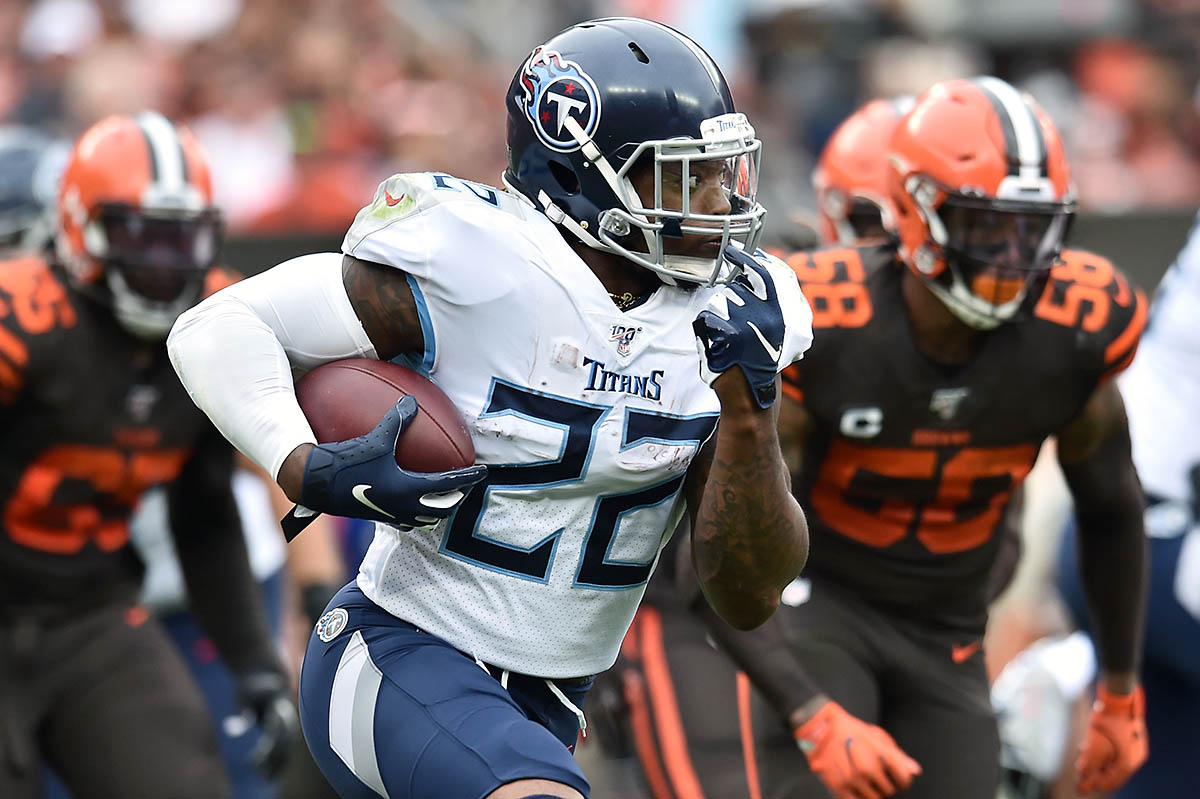
Nashville, TN – Tennessee Titans running back Derrick Henry finished 2019 with a league-high 1,540 yards on 303 rushing attempts (4.8 avg.). His 16 rushing touchdowns put him in a tie with Green Bay Packers’s Aaron Jones atop the league leaderboard and placed second in franchise annals.

Over the final six weeks of the regular season plus three playoff appearances, Henry totaled seven 100-yard games.

Tennessee Titans running back Derrick Henry (22) runs with the ball during the first half against the Cleveland Browns at FirstEnergy Stadium. (Ken Blaze-USA TODAY Sports)

From the regular season final through the divisional round, he became the first player in NFL history to rush for at least 180 yards in three consecutive regular season and/or postseason games.

In addition to being selected to his first Pro Bowl, Henry’s postseason honors included second-team Associated Press All-Pro recognition and the FedEx Ground Player of the Year award.

RB Derrick Henry 2019 Accomplishments

  • Selected to his first career Pro Bowl.
·        Named the NFL’s FedEx Ground Player of the Year.
·        Named second-team All-Pro by the Associated Press.
·        Named to the PFWA’s All-NFL team.
·        Led the NFL with a career-best 1,540 rushing yards. He also established career highs with 303 carries and 16 rushing touchdowns (tied for the NFL lead).
·        Recorded his second consecutive 1,000-yard rushing season.
·        Added 18 receptions for 206 yards with two receiving touchdowns, all of which set career-highs.
·        Led the AFC, ranked third in the NFL, and led the team with a career high 18 total touchdowns.
·        Ranked second in the AFC and fourth in the NFL with a career-high 1,746 yards from scrimmage.
·        Finished the season with the fourth-best rushing yardage total in franchise history, and ranked second in franchise history with 16 rushing touchdowns.
·        Recorded eight total 100-yard rushing performances in 2019 (six regular season and two postseason games).
·        Moved into fourth place on the franchise’s all-time rushing touchdowns list (38).
·        Named AFC Offensive Player of the Week after his performance at Houston (12/29), where he rushed a season-high 32 times for a season best 211 yards with three touchdowns to secure the NFL’s rushing title.
  • Became the sixth player in franchise history with at least 12 touchdowns in two or more consecutive seasons.
·        Joined Napoleon Kaufman (1997-99) and Robert Smith (1997-2000) as the only players in NFL history to record a rushing touchdown of at least 70 yards in three consecutive seasons.
·        Passed Steve McNair (3,439 career rushing yards) for sixth place on the team’s all-time rushing list, and later passed Hoyle Granger (3,514) for fifth place on the team’s all-time rushing list.
·        Has posted 24 rushing touchdowns in his past 20 regular season games, which leads the NFL in that time period.
·        Started all three playoff games and finished the postseason with 83 carries for a league-best 446 yards and two touchdowns, all of which set career highs.
·        His 446 rushing yards in the postseason ranked second in franchise playoff history behind Eddie George’s 449 rushing yards during the 1999 playoffs.
·        At the New England Patriots (1/4/20), set a then-franchise playoff record with 182 rushing yards on 34 carries with a touchdown, which marked the second-most yards on the road in an NFL playoff game since 1950.
·        At the Baltimore Ravens (1/11/20), set a franchise playoff record with 195 rushing yards on 30 carries.
·        Threw a three-yard touchdown pass to Corey Davis in the playoffs, marking his first career touchdown pass.

Popular Posts